Where to Start
Writing your vows can feel oddly exposing. Choosing a venue, flowers and music is one thing. Standing in front of the person you love – and everyone they love too – and saying something deeply personal out loud is quite another.
If you are wondering how to personalise wedding vows without sounding forced, overblown or unlike yourself, the good news is that you do not need to become a poet overnight. The most moving vows are rarely the grandest. They are the ones that feel honest, well chosen and unmistakably yours.
What personalised vows should actually do
Personal vows are not a performance. They are a promise. That distinction matters, because it takes the pressure off trying to be endlessly witty, tear-jerking or profound.
At their best, vows do three things.
- They reflect your relationship as it truly is.
- They express what you value in your marriage.
- Vows give your partner something real to hold onto after the confetti has settled. That might sound simple, but it is where many couples get stuck. They either write a love letter, which can be beautiful but not always vow-like, or they write something so formal it could belong to almost anyone.
The sweet spot sits between the two. Your vows should sound like you on your best day – sincere, clear and emotionally present.
How to personalise wedding vows without overthinking them
A blank page makes everything feel harder than it is. Rather than trying to write your vows from beginning to end in one sitting, start by gathering material.
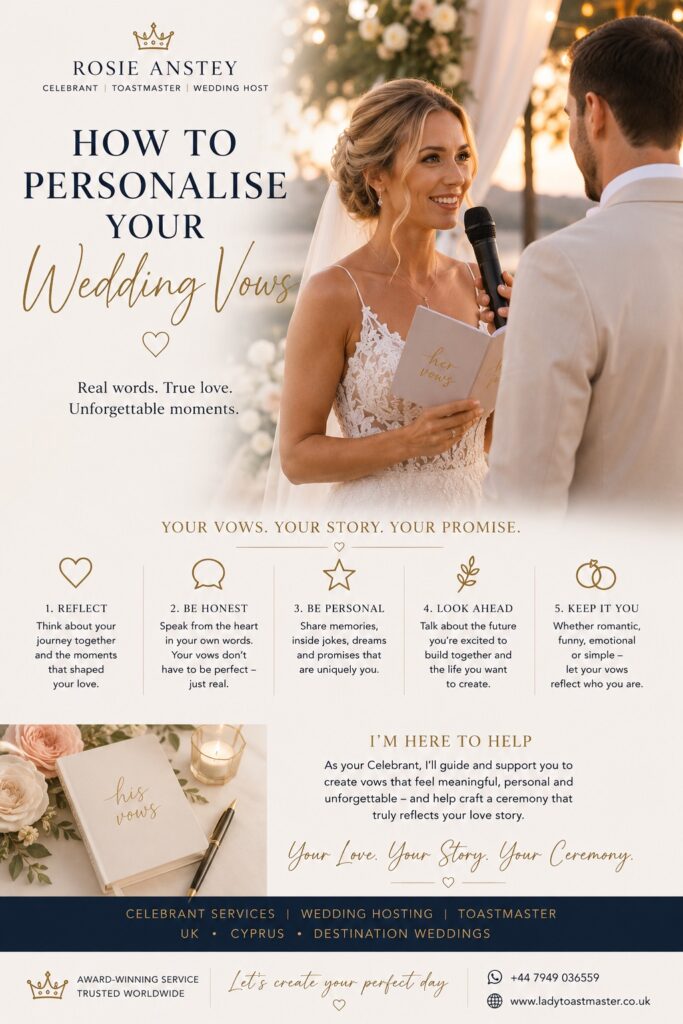
Think about the moments that define your relationship. Not the entire history, just the details that reveal something meaningful. It might be the first time your partner made you feel safe. It might be the way they steady you when life is hectic, or the fact that they always know when to make you laugh. Very often, the most personal material comes from ordinary moments rather than dramatic ones.
Ask yourself a few quiet questions.
*What do you admire most about them now?
*What has this relationship taught you?
*What kind of marriage are you actively choosing?
*What do you want your partner to feel when they hear these words?
Once you have those answers, patterns tend to emerge. You may realise that loyalty matters more to you than romance, or that humour is a cornerstone of your life together. Those themes become the backbone of your vows.
Start with your real relationship, not someone else’s
It is very easy to absorb other people’s language. Social media, films and wedding blogs are full of perfectly polished lines, but many of them flatten individuality. If you borrow too heavily from what sounds romantic in theory, your vows can lose the warmth of your actual voice.
Instead, use your own relationship as your source material. If you are understated as a couple, your vows do not need dramatic flourishes. If you are playful, a touch of humour may feel exactly right. If your story includes blending families, long-distance love, a second marriage or a destination wedding after years of waiting, that context can shape the tone beautifully.
There is room for elegance and personality at the same time. Personalised does not mean overly informal. It means specific.
A structure that makes vow writing easier
Most couples find it easier to write good vows when they stop aiming for perfection and give themselves a shape to work within.
A strong set of vows often begins with a brief statement of love or recognition. Then comes the heart of it – what you cherish about your partner and your relationship. After that, you move into the promises themselves. Finally, you end with a simple closing line that feels grounded and confident.
That structure helps your vows feel coherent rather than rambling. It also keeps them balanced. If you spend two minutes telling stories and only ten seconds making promises, they can feel more like a speech than vows.
The promises are the anchor. They are what make wedding vows distinct from a reading, a toast or a private letter.
What kind of promises should you include?
The best promises are meaningful enough to matter and realistic enough to live by. Grand declarations can sound impressive in the moment, but if they are vague, they do not carry much emotional weight.
Promises such as always making your partner tea on a Sunday morning may be charming if that ritual means something to you both. Promising to listen with kindness, to protect time for one another, to stand steady during change, or to choose each other with patience and generosity often lands more deeply because it speaks to real married life.
A few lighter lines can work beautifully, particularly if humour is part of your bond. The key is proportion. One or two warm, recognisable touches can bring smiles. Too many jokes and the emotional thread can disappear.
How to keep personalised vows balanced as a couple
One of the biggest worries couples have is ending up with mismatched vows – one person delivers a beautifully crafted reflection and the other offers three hurried lines and a joke about loading the dishwasher.
You do not need to write together, and in many cases it is better if you do not. The surprise is part of the magic. But it is wise to agree on a few parameters in advance. Decide roughly how long your vows should be, whether you want them to be more romantic or more light-hearted, and whether there are any themes you both want to include.
This does not make the process less personal. It simply means neither of you is blindsided on the day.
For many couples, around one to two minutes each is ideal. Long enough to say something meaningful, short enough to stay present. If one of you is naturally more expressive than the other, that is perfectly fine. Matching tone matters more than matching word count exactly.
Personal does not have to mean private
Some couples worry that personalised vows must include highly intimate stories to feel special. They do not. In fact, the most effective vows are often selective rather than revealing.
Ask whether a detail deepens the moment or simply exposes it. A private reference can be lovely if your partner will instantly understand its significance. But if a story needs a long explanation, or might make either of you uncomfortable in front of guests, it is probably better saved for a card exchanged beforehand.
Your vows can be deeply emotional without giving the room every chapter of your relationship.
Writing for a multilingual, multicultural or blended ceremony
For couples bringing together different cultures, faiths or family traditions, personal vows can become especially powerful. They offer a chance to speak from the centre of your shared life, even when the wider ceremony includes several influences.
In that setting, clarity matters. If some guests may not speak English fluently, simpler language can be more inclusive than ornate phrasing. If you are honouring both heritage and individuality, a carefully chosen reference to family values, tradition or the journey that brought you together can add tremendous depth.
The same applies in second marriages or ceremonies involving children. Personal vows may gently acknowledge the life you are building, not only as a couple but as a family. Done with care, that can be incredibly moving.
A skilled celebrant can help shape this so it feels cohesive, especially when there are cultural nuances or emotional dynamics to navigate.
Editing is where good vows become memorable
First drafts are usually too long, slightly repetitive or trying too hard. That is normal. Writing well is often rewriting.
Once you have a draft, read it aloud. You will hear very quickly where the language is stiff, where a sentence runs on too long, or where something sounds lovely on paper but awkward in your own voice. Wedding vows are spoken, not silently admired.
Trim anything that feels generic. Replace broad statements with more exact ones. “You are amazing” is kind but indistinct. “You bring calm when life feels loud” says far more.
It also helps to check the rhythm. Shorter sentences often carry more emotion than heavily decorated ones. If you become tearful easily, build in places to pause. That is not a failure in delivery. It is part of a human one.
If you are nervous about saying them aloud
Even beautifully written vows can wobble when nerves appear. That is completely understandable. The answer is not to make them less personal. It is to prepare well enough that emotion does not derail you.
Print them clearly on a card rather than relying on your phone. Practise aloud several times, slowly. Focus on speaking to your partner, not performing for your guests. If tears come, pause and breathe. Nobody expects a polished theatre performance. They are listening for truth.
And if public speaking fills you with dread, keep your language straightforward. The simpler and more natural the words, the easier they are to say with confidence. Find out more about Celebrant Services in Cyprus
The question to ask before you finish
Before you settle on your final version, ask yourself one thing: could these vows belong to anyone else?
If the answer is yes, they may need a little more of your real life in them. Not more drama, just more specificity. A detail, a promise, a phrase you would genuinely say. That is usually where the feeling lives.
The most memorable vows are not the most elaborate. They are the ones that sound true when spoken aloud, in that moment, to that person. If your partner hears your words and thinks, this is exactly us, then you have written something worthy of the day.
Need some help?
If you would like some help or guidance on writing your personal vows, I’d be delighted to help you.
Rosie Anstey