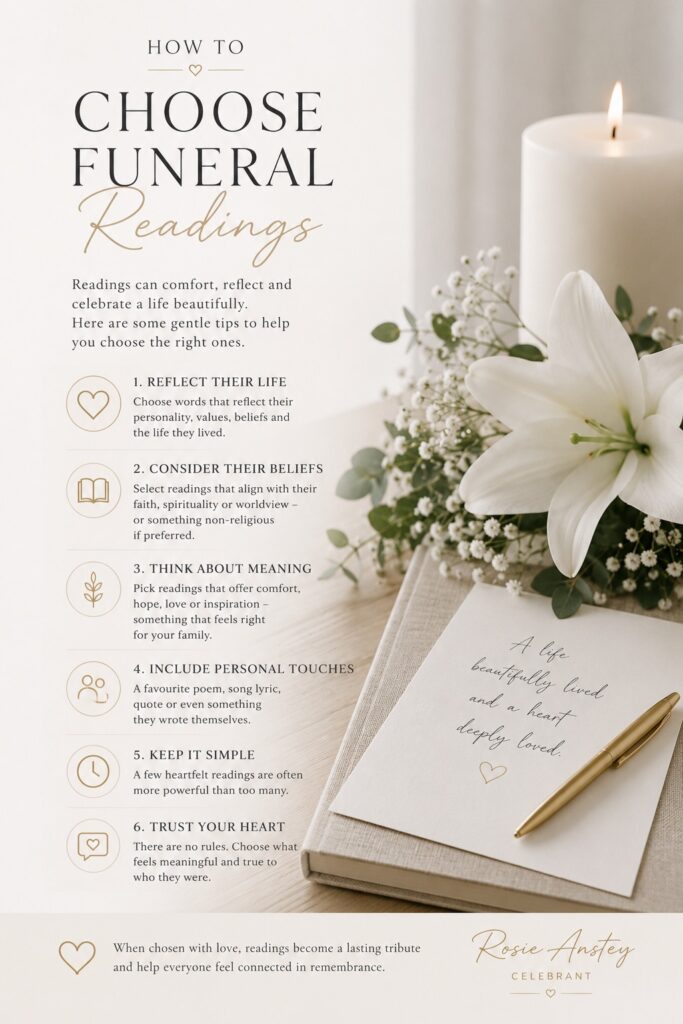
In the days after a loss, even small decisions can feel unexpectedly heavy. If you are wondering how to choose funeral readings, you are not alone. Families often want words that offer comfort, reflect a life honestly, and sit gently within the tone of the service, but knowing where to begin is not always easy.
The right reading can steady a room. It can give voice to grief, bring a smile of recognition, or say something beautiful when those closest to the person feel they cannot find the words themselves. It does not have to be famous, religious, poetic or profound in a grand sense. It simply needs to feel true.
How to choose funeral readings that feel right
A good place to start is not with books or websites, but with the person you are remembering. Think about how they lived, what mattered to them, and how they would want to be held in people’s minds. Were they quietly spiritual, deeply family-centred, dryly funny, practical, romantic, traditional, unconventional? A reading should support that picture rather than fight against it.
Some families feel drawn to readings that speak directly about loss and remembrance. Others prefer something lighter, perhaps a piece about love, friendship, nature or continuity. Neither approach is better. It depends on the person, the family, and the atmosphere you hope to create.
The tone of the service matters more than many people expect. A formal crematorium service with hymns and prayers may call for something different from a relaxed celebration of life in a garden, hotel or family venue. If the ceremony includes faith elements, a secular poem can still sit beautifully alongside scripture, but it should feel intentional. Equally, if the farewell is non-religious, a reading with spiritual language may still be absolutely right if it reflects genuine beliefs.
Begin with the person, not the literature
When families try to choose too quickly, they often reach for the readings they have heard before. Familiar pieces can be deeply moving for a reason, and there is nothing wrong with choosing a well-known poem or passage. Still, it is worth pausing to ask whether it suits this particular person, or whether it simply feels like what funerals are meant to include.
Try thinking in memories rather than categories. What did they say often? What made them laugh? Did they love the sea, gardening, music, dogs, travel, church, cooking for everyone, or long walks on a Sunday? Sometimes the best reading emerges from those details. A short extract from a novel they adored or a few lines from a song lyric can feel more personal than a classic funeral poem chosen in haste.
If several family members are involved, ask each person for one word they want the service to convey. You may hear words such as comforting, elegant, uplifting, honest, peaceful or warm. Those answers can help narrow your choices. If one reading feels too sombre and another too cheerful, that usually tells you something useful.
Religious, spiritual or non-religious?
This is often the first practical decision. If the person had clear beliefs, that may guide you naturally. A Bible reading, prayer or faith-based poem can offer great comfort where belief was central to their life. For some families, that familiar language is an essential part of farewell.
For others, a non-religious reading feels more authentic. That might be poetry, prose, a reflective letter, or even a piece written by a family member. Spiritual but not doctrinal readings can also bridge different beliefs in one family, especially where guests come from mixed cultural or religious backgrounds.
It is perfectly acceptable to blend styles. A thoughtful ceremony often holds more than one voice. A traditional reading can sit alongside something modern and personal, creating balance between formality and intimacy.
Choose something readable aloud
A reading may look lovely on paper and yet feel awkward when spoken. Funeral ceremonies are heard, not just read, so rhythm matters. The language should sound natural in the room and be manageable for the person delivering it.
Very long sentences, dense imagery or highly abstract writing can lose people, particularly when they are emotional. Shorter pieces often land more gently. If a reading is meaningful but overlong, an extract may work better than the full version.
Read it aloud slowly. Better still, ask someone else to read it to you. You will quickly hear whether it brings calm and clarity, or whether it feels strained. A piece that sounds simple can be the most powerful of all.
How to choose funeral readings for the people in the room
A funeral is centred on one life, but it also holds the needs of those left behind. That does not mean trying to please everyone, which is rarely possible. It means choosing words that feel considerate of the people gathering to say goodbye.
If children will be present, a reading with warmth and plain language may feel kinder than one that is very bleak. If there has been a difficult illness or complicated family history, some pieces may feel too neat or sentimental. The best ceremonies do not pretend grief is tidy. They create space for truth, tenderness and humanity.
Cultural context matters too. In some families, a formal literary piece may feel respectful. In others, it may feel distant. If your family spans traditions or countries, a bilingual reading or a short text from each culture can be a lovely way to honour the whole story.
One reading or several?
There is no fixed rule. One carefully chosen reading can be enough, especially in a shorter service. Two or three can work beautifully if each one has a different purpose. For example, one might offer reflection, another might speak more personally about character, and a final piece might send people out with comfort.
What matters is pacing. Too many readings can make a ceremony feel fragmented. Too few can leave it feeling abrupt. A celebrant or officiant can help shape this so the words support the flow rather than interrupt it.
Who should read it?
This question deserves real thought. Sometimes the most obvious person is not the best person for the task. A close relative may dearly want to read but feel unable on the day. That is not letting anyone down. Grief is not a performance.
If someone does wish to read, choose a piece that suits their voice and confidence. A shorter text is often kinder. If there is any doubt, the reading can be shared between two people or read by the celebrant on the family’s behalf. What matters is that the words are delivered with care, not that the speaker pushes beyond what they can manage.
What makes a funeral reading memorable?
Usually, it is not literary brilliance. It is recognition. Guests listen and think, yes, that sounds like them. Yes, that is exactly what they brought to the world. A memorable reading feels grounded in real character.
That might mean choosing a much-loved classic, but it can just as easily mean selecting something modest and heartfelt. Some of the most affecting readings are short enough to fit on a card. They leave room for silence, which is often where meaning settles.
If you are torn between several choices, ask yourself a simple question: which one would I be glad people heard when they think back on this day? Not which one is most impressive, but which one feels most faithful.
For families who want a bespoke ceremony, this is often where professional guidance makes all the difference. An experienced celebrant can help you weigh tone, timing, belief, family dynamics and delivery, so the final choice feels both personal and well placed.
You do not need to find the perfect words. You only need words that honour the person honestly, support those who are grieving, and feel right when spoken aloud. Very often, when you find the right reading, you know. It brings a small moment of stillness in the middle of a difficult time, and that is more than enough.
A Beautiful Goodbye.
A Beautiful Goodbye: A Practical and Compassionate Guide to Creating a Meaningful Funeral, Memorial or Celebration of Life. Available now on Kindle.